Occam’s razor
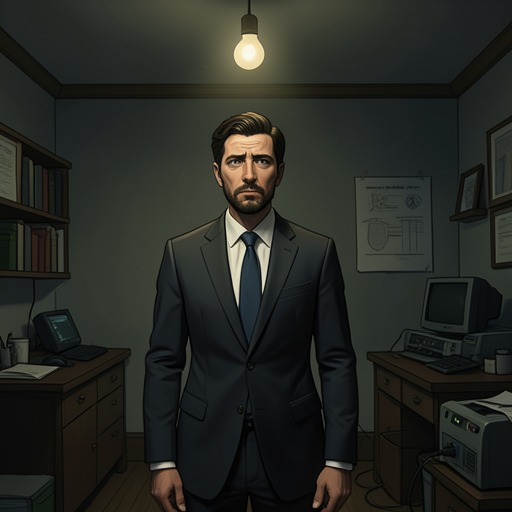
Straight ManOccam’s razor is William Henry Devereaux Jr.’s recurring rule for preferring a simple explanation over one burdened with unnecessary assumptions. He invokes it to interpret campus rumors, family behavior, and sudden complications in his own life; the rule offers him a comic, disciplined way to sort evidence, but its repeated failure to settle human motives becomes one of the novel’s central ironies. Rational simplicity can clarify what happened without explaining what it means.
The rule as a habit of thought
In William Henry Devereaux Jr.’s account, the razor is William of Occam’s principle that “entities must not be multiplied beyond what is necessary.” It functions less as an abstract philosophical lesson than as a habit of interpretation: begin with the available facts, resist elaborate speculation, and prefer the account that explains them without needless additions. William Henry Devereaux Jr. treats this method as both intellectual discipline and personal refuge, returning to it whenever uncertainty threatens to proliferate.
His annual response to faculty-purge rumors shows the rule applied to institutional life. Every April, he recalls, anxiety about higher-education budgets rises; rumors spread, a task force lobbies for spending, accusations and editorials follow, and threatened reductions are eventually softened when money is found. He expects further belt-tightening, denied sabbaticals, a prolonged hiring freeze, and smaller photocopy budgets, but rejects the more dramatic prediction of a faculty purge. The pattern of previous years supplies a simpler expectation: another cycle of rumors and limited cuts, rather than a wholesale purge. Yet repetition does not abolish the rumors. The razor gives him a way to judge them, not a way to stop their return.
The same method appears in his reflection on his writing career. Approaching fifty, he sees that the book he published at twenty-nine remains his only book. He considers whether a more demanding academic environment might have produced another, then uses Occam’s razor to arrive at a harsher explanation: he may simply be a one-book author. His terse conclusion, “Had I been more, I’d be more. Simple,” turns the principle inward. Here simplicity is not reassurance but a refusal to multiply excuses for an outcome he finds difficult to accept.
Campus, family, and the long reach of causes
The razor also figures in William Henry Devereaux Jr.’s account of how immediate incidents may grow from old causes. Lily argues that purchasing two adjacent lots near their home helped set in motion the English Department Wars and, eventually, the chain of events that led Gracie DuBois to attack him with a spiral notebook. William Henry Devereaux Jr. recognizes that the chain is too long to establish while its participants are still alive. Still, he entertains the possibility that a remote grievance can matter more than a recent one: Paul Rourke’s enduring hostility, he suggests, may ultimately trace back to William Henry Devereaux Jr.’s refusal to sell him a lot nearly twenty years earlier. The razor pulls toward a single originating cause, even as the scale of the proposed chain makes certainty impossible.
The history of development on the hill gives that speculation concrete context. Clearing a service road prompted other buyers to build there. Jacob Rose became dean and bought the largest remaining lot, while Finny and his wife bought another at the bottom of the hill. Concern that nearby colleagues would erase the privacy the Devereauxes had sought led William Henry Devereaux Jr. to borrow money for an adjacent lot, despite Lily’s reluctance to take on more debt. The episode suggests how practical choices can acquire a longer institutional afterlife: a decision about land becomes, in Lily’s interpretation, an early link in departmental conflict.
At home, the razor becomes an argument about candor and pretense. Lily believes in presenting the best possible face toward their daughters’ choices and giving them room to fail. William Henry Devereaux Jr. objects that pretending a plainly risky decision is wise creates further pretenses, each requiring another explanation. He also resents being asked to act surprised by predictable news in order to spare someone’s feelings. His preference for the simple truth clashes with Lily’s concern for tact, and neither position erases the other’s consequences. When Julie and Russell build a house, the couple lends them money while William Henry Devereaux Jr. keeps his doubts largely to himself; he later recognizes that his silence may have withheld the support Lily thinks their daughter needs.
His belief in straightforward interpretation is tested by Julie’s intuition. When she asks why her parents never jog together, he wonders whether she has noticed something larger in their marriage, then chooses the ordinary explanation that Lily dislikes his pace. The simplest account is available, but his own unease makes him suspect the question may carry another meaning. The moment leaves the razor less like an automatic answer than a standard he wants to trust.
When evidence is not enough
Several scenes show William Henry Devereaux Jr. reaching for the principle as a way to contain anxiety. A campus excavation for a new technical careers building should, he reasons, contradict rumors that the university plans to dismiss tenured faculty while claiming financial hardship. But the same hole in the ground also provokes a darker possibility: perhaps the project will not be built after all. He recognizes that this more elaborate scenario is difficult to reconcile with the visible evidence, yet cannot make the unease disappear. The practical fact of a funded construction project offers a sound argument; imagination continues to generate alternatives.
He uses the razor more playfully in a dispute about a football wager. Teddy Barnes adds conditions based on overall records and playoff outcomes, while William Henry Devereaux Jr. objects that a game between the two teams ought to settle the question directly. His protest is an attempt to strip a wager of complications by returning to what seems the decisive contest. In a different register, that same preference for a clean account shapes his reflections on thought and conduct. Faced with the possibility that merely contemplating adultery makes him morally identical to his father, William Henry Devereaux Sr., he rejects an argument that collapses thought into action. For him, equating the two needlessly complicates justice by treating an imagined deed as though it had been committed. Yet he also acknowledges that thoughts matter, leaving the distinction principled but not emotionally simple.
Medical uncertainty exposes another limit. When a doctor identifies an asymmetry that may require further examination, William Henry Devereaux Jr. tries to reduce the situation to a single, adequate feeling: fear of mortality. Instead, he notices an exhilaration that this explanation cannot contain. He asks whether a more remote possibility could account for his symptoms, but says the problem does not feel psychological. The episode turns his preferred method back upon his own experience: even when a simple explanation is available, it may not account for the full response.
Inference, misreading, and the novel’s counterpoint
William Henry Devereaux Jr. sometimes applies the razor successfully to incomplete evidence. After seeing a woman removed from campus by police and learning that Tony Coniglia has canceled their racquetball match, he connects the woman to an earlier visit to Tony’s home and infers that she interrupted Tony’s class. The account fits several observations without contradicting them. But he immediately distinguishes that factual reconstruction from understanding the reasons behind the events. The sequence can be pieced together; the motives and meanings remain unknown.
Tony’s mock detective work over a mess on William Henry Devereaux Jr.’s car makes the distinction comic. Tony supplies a confident collection of details about an imagined culprit, while William Henry Devereaux Jr. considers how little such particulars can reveal about people’s lives. His own inference, too, cannot tell him what lies behind the facts. He compares the limits of intuition with the demands of fiction: an artist must do more than collect details or identify a plausible pattern. Rachel’s developing confidence in her work sharpens the contrast. William Henry Devereaux Jr. envies not simply her success, but her ability to believe that her talent can carry her forward.
The razor’s most sustained irony emerges amid department politics. During a meeting, Orshee proposes that the colleagues try to be friends, but the motion receives no second. June Barnes’s response leads William Henry Devereaux Jr. to suspect a connection between her and Orshee, though the scene yields no definitive explanation. Above the meeting, in a filthy crawl space, he confronts evidence that his friends and enemies alike regard him as out of control. His position as department chair, his published book, and his carefully dressed professional appearance do not fit the fact that he is hiding above the ceiling, reluctant to return to the room below. The simple description of his circumstances is difficult to evade, but it does not resolve the deeper question of how he arrived there.
When he finally escapes Modern Languages, William Henry Devereaux Jr. misreads a car beside his as evidence of a young couple seeking privacy. The person who appears is Russell, waiting for him. The small mistake captures a recurring pattern: a plausible explanation can account for what is visible and still be wrong about the people involved. Later, in a jail cell, he sees Tony and concludes that Tony could not have answered his telephone because he was not there to answer it: “If he’s here, he can’t be there.” The deduction is logically neat, and its immediate facts support it. But the scene also makes room for the unexplained wonder Tony values and William Henry Devereaux Jr. usually tries to dispel.
His final reflections on William of Occam extend the rule beyond everyday inference. He imagines the philosopher excommunicated, writing pamphlets, and dying of the Black Death at sixty-four, fourteen years older than William Henry Devereaux Jr. is at the time of the comparison. The sudden, indiscriminate force of that death defeats the promise that reason can make life orderly. Occam’s razor remains valuable as a means of judging explanations, but the novel refuses to let it become a universal key: evidence can establish a sequence, and simplicity can discipline speculation, while motives, chance, illness, and loss remain more complicated than the facts alone can settle.